Reader's Theater for Kids (The Fun Version)
Reader's theater builds reading fluency by giving kids a real reason to read aloud: a part to perform. Here is how it works at home and in class, plus the easiest version of all.

Ask a kid to read a worksheet aloud and you get a flat, careful mumble. Hand the same kid a part to play, a wicked witch or a grumpy troll, and watch what happens. Suddenly they are reading with a voice, leaning into the words, reading the line again to nail the delivery.
That swap is the entire idea behind reader's theater. It turns reading practice into a performance, which means kids reread willingly instead of being forced to. This is the plain-English version: what it is, why it genuinely builds reading fluency, and the easiest way to run it.
What reader's theater actually is
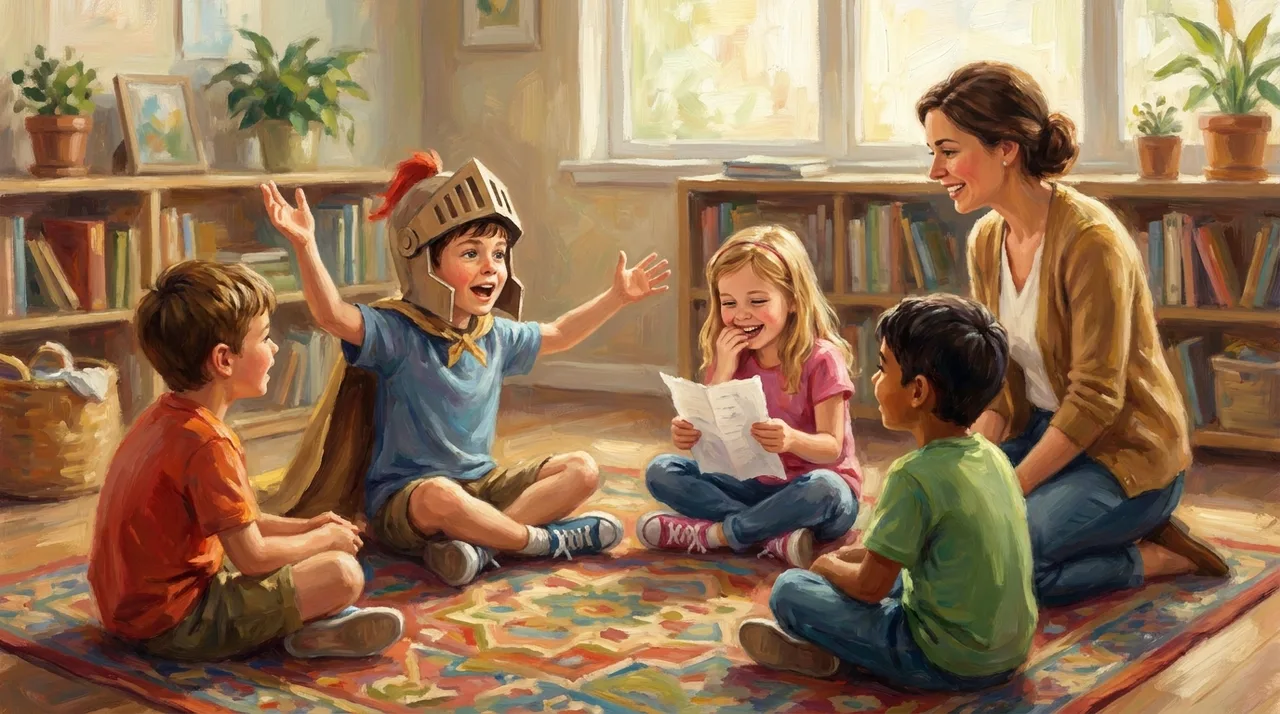
Reader's theater is a group reading activity where each kid gets a part in a script and reads it aloud to an audience. There are no costumes, no sets, and crucially no lines to memorize. The script stays in their hands the whole time.
That last detail is the magic. Because nobody has to memorize anything, the reading itself is the performance. Kids reread their part several times to get the words smooth and the expression right, and that repetition is doing real work under the hood.
Reading Rockets calls it a strategy that gives students a real reason to read aloud, and that framing matters. The point is not to test the kid. The point is to make rereading feel like rehearsal for a show they actually want to put on. You can see the full classroom breakdown in this Reading Rockets guide to reader's theater.
Why it builds reading fluency (the real reason)
Fluency is one of the five core components of reading the National Reading Panel identified, alongside phonemic awareness, phonics, vocabulary, and comprehension. It is the bridge between sounding out words and actually understanding them. A fluent reader recognizes words and grasps meaning at the same time, instead of burning all their attention on decoding.
Reader's theater hits fluency from three directions at once, which is why it punches above its weight as an activity.
- Repeated reading. Reading the same passage several times is one of the best-supported ways to build reading speed and accuracy. Reader's theater smuggles in that repetition as rehearsal, so kids do it gladly. The research on developing fluent readers keeps coming back to repeated reading for exactly this reason.
- Prosody, the music of reading. Prosody is expression: phrasing, pitch, pauses, the difference between a robot and a storyteller. Performing a character pushes kids to read WITH feeling, and that expressive practice is strongly tied to comprehension.
- A reason to read for real. A worksheet asks a kid to read because they were told to. A script asks them to read so the scene works and the audience laughs. That authentic purpose is the part a worksheet can never fake.
The classroom results back this up. A second-grade study found reader's theater drove gains in word recognition, automaticity, and prosody. The Iowa Reading Research Center has a clear writeup of why drama-based fluency practice works if you want the evidence in one place.
This matters more than it used to. The 2024 national reading scores fell again for fourth and eighth graders, continuing a slide that started years ago, which the national reading report card tracks in detail. Activities that get kids reading aloud willingly, on their own steam, are worth their weight right now.
How to run reader's theater at home
You do not need a teaching degree or a single prop. You need a short script, two or more readers, and a willing audience, which can be a parent, a sibling, or a very patient dog.
Pick a short, punchy script
Start small. A folktale, a fable, or a silly two-character scene is plenty for a first try. Look for scripts with short lines and a narrator part, because shared narration keeps everyone reading instead of one kid hogging the page.
Assign parts and rehearse a few times
Hand out the roles and read it cold the first time, mistakes and all. Then read it again, and again. Three to five rehearsals is the sweet spot, and each pass gets noticeably smoother as the words become familiar.
Coach for expression, not perfection. Ask how the witch sounds when she is angry, or how the mouse talks when he is scared. That nudge toward voice is you teaching prosody without ever using the word.
Perform it for someone
The audience is the whole point. Even one parent on the couch turns rereading into a real event with a payoff. Clap, laugh at the funny line, ask for an encore, and the kid learns that reading aloud earns a reaction worth chasing.
Reader's theater in the classroom
Teachers have run this for decades because it scales and it works. The mechanics are the same as at home, just spread across a group, and the social pressure of a real performance day raises the stakes in a good way.
- Group by mixed ability. A struggling reader can take a shorter part and still fully belong to the scene. Nobody is benched.
- Rehearse across the week. A few short rehearsals beat one long slog, and a Friday performance gives the week a finish line.
- Keep it low-stakes. No memorizing, no grades on the performance, no costumes required. The script in hand removes the fear that kills oral reading confidence.
For ready-made material, there is a deep well of free scripts online. Reading A-Z hosts a large library of leveled reader's theater scripts, and the Iowa Reading Research Center publishes classroom-tested scripts grouped by grade band. Start with a level slightly below the reader so the first pass feels like a win.
New adventures, straight to your inbox
Get the StartRPG newsletter for fresh one-shots, game night ideas, and tips for hosting a table with friends.
We respect your privacy. Unsubscribe at any time.
Age tips, roughly
Match the script to the reader, not the calendar. A confident seven-year-old can outperform a reluctant ten-year-old, so use the words on the page as your guide, not the birth certificate.
- Early readers (around 5 to 7). Tiny scripts, repeated refrains, lots of narrator support. Two short lines per kid is a triumph at this age.
- Building readers (around 8 to 10). Real characters, dialogue, a clear beginning and end. This is the prime zone for reader's theater, and where prosody really blooms.
- Older kids (11 and up). Longer scenes, more characters, room for comedy and drama. Let them ham it up; the bigger the performance, the more rereading they will happily do.
The fun version: a script that writes itself
Here is the catch with classic reader's theater. Someone has to find the script, print it, and assign the parts, and the same fable can get stale on the third reread. Kids will perform a story they helped invent far more eagerly than one handed to them.
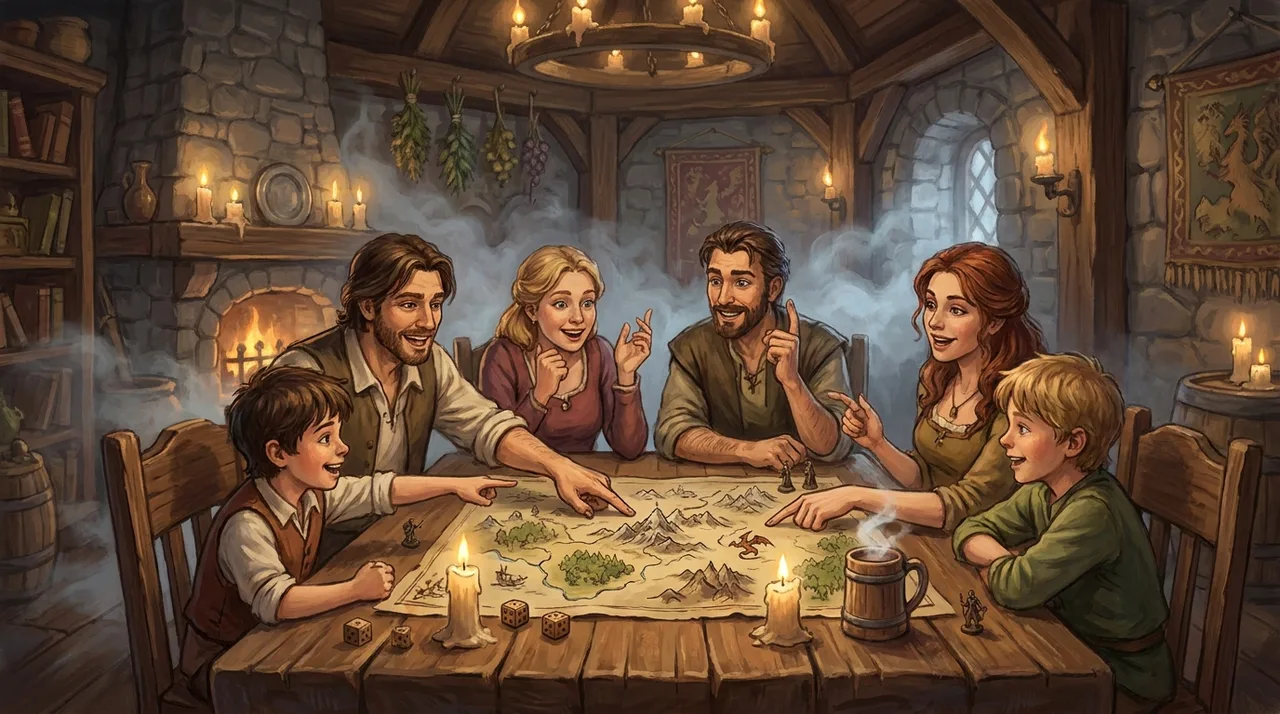
Now look at what a tabletop role-playing game is. Every player runs a character and reads that character's moment aloud, in their own voice, to the rest of the table. The spotlight rotates, so everyone gets a turn to read, react, and perform.
That is reader's theater that writes its own script. There is no worksheet, no memorizing, and a built-in audience of friends who are leaning in to hear what your character says next. The reason to read is baked right in: you read so you can play.
Stranger Things put this kind of fantasy adventure back in front of a whole new generation, and the kids who fell for the show want to actually play it. A tabletop quest gives them the same expressive, read-aloud, take-your-turn loop that makes reader's theater work, wrapped in a story they get to steer.
If you are brand new to the format, my walkthrough of how a tabletop RPG actually plays shows the back-and-forth in plain terms. And for the deeper dig on the reading side, my piece on how tabletop adventures build reading comprehension connects the dots between play and literacy.
How to run it with zero prep
This is exactly the friction StartRPG removes. One person starts a game, friends or family join with a room code from their own phone or laptop, and a tireless Game Master sets every scene and reacts to whatever the players try. Nobody has to write a script, run the table, or read a rulebook first.
Each kid types or reads their character's choices aloud, the story responds, and the turn passes to the next player. It is a fresh adventure every time, so the rereading energy of reader's theater never goes stale on a repeated fable. When you want to try it, you can start an adventure with friends in about a minute.
One honest note: this is a story-first adventure kids steer with their choices, not a reading-level dial or a graded lesson plan. It is a fantasy role playing game, so the story can include danger, monsters, and combat, and there is no grade control, no curriculum dashboard, and no kid mode yet. Pick the Lighthearted romp mood for the lightest tone, play a quest yourself first to vet it, and what you get is the read-aloud, take-your-turn, perform-for-your-friends loop that gets kids reading because they WANT to.
Frequently asked questions
What is reader's theater for kids?
Reader's theater is a group activity where each kid gets a part in a script and reads it aloud to an audience. There are no costumes, no sets, and no memorizing, because the script stays in hand the whole time. The rereading and the expressive performance are what build reading fluency.
Does reader's theater actually improve reading fluency?
Yes. It combines repeated reading, expressive practice, and a real reason to read, which are three of the strongest levers for fluency. Classroom studies have found gains in word recognition, reading speed, and expression after even a few weeks of regular practice.
Where can I find reader's theater scripts?
There are many free libraries online from reading organizations and educators, grouped by grade level. Start with a script slightly below the reader's level so the first read feels like a win, then move up as confidence grows.
How is a tabletop RPG like reader's theater?
In a tabletop role-playing game, every player reads their character's moment aloud and the spotlight rotates around the table. It is reader's theater that writes its own script, with a built-in audience of friends and a story the players steer. The reason to read is baked in: you read so you can keep playing.
What age is reader's theater good for?
It works from early readers through middle school, as long as the script matches the reader. Younger kids do best with tiny parts and repeated refrains, while older kids can take on longer scenes with real dialogue and bigger performances.
Turn reading into an adventure
Give your kids a story where every player reads their part aloud and the spotlight rotates. A tireless Game Master runs the rest. No script to write, no prep, free to play.