How to Play a Tabletop RPG (No Rulebook)
New to tabletop RPGs and not sure how to actually play one? Here is the plain-English version: no rulebook, no math, and your first quest starts in about a minute.
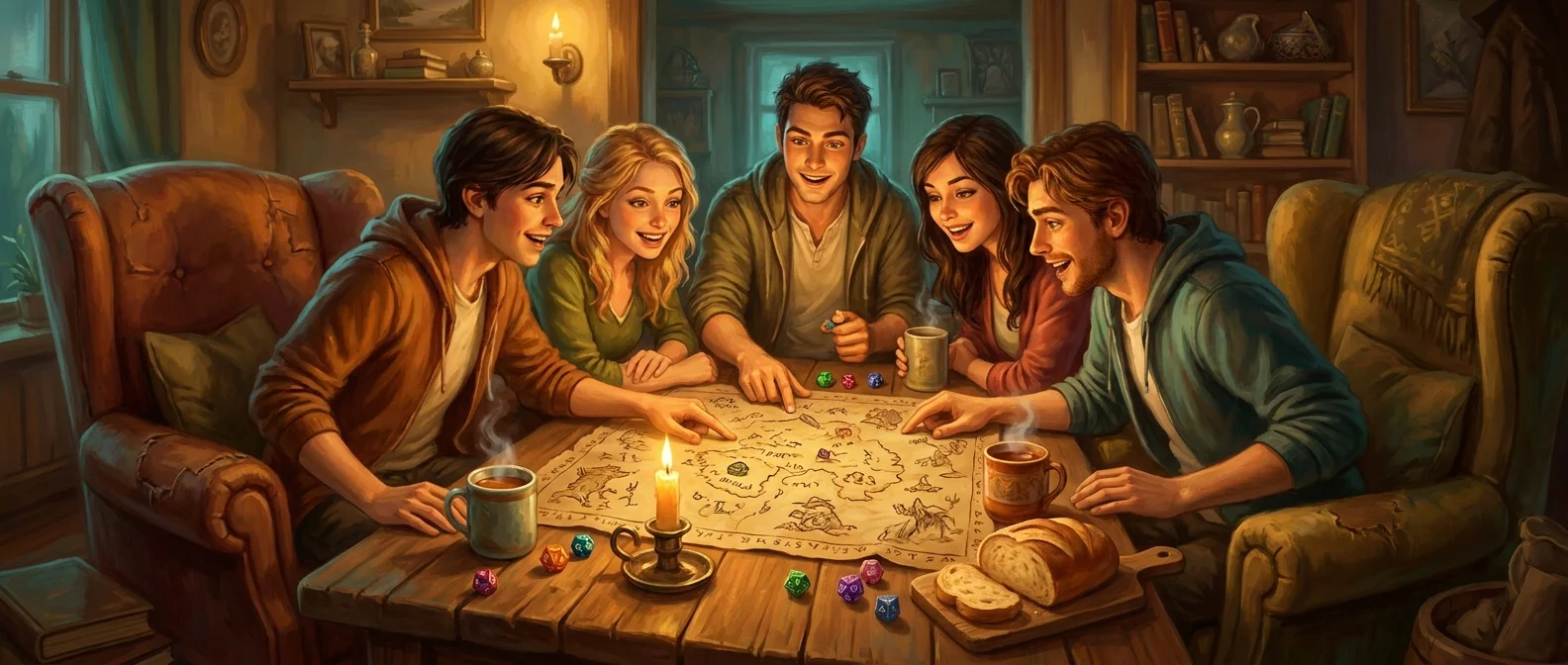
Search how to play a tabletop RPG and you mostly find walls of rules. Ability scores, dice charts, combat rounds, a shopping list of gear. For someone who just wants to try a fantasy adventure with friends, that reads like a college syllabus, not an invitation.
So here is the honest, jargon-free version. A tabletop RPG is simpler than it looks, and you can be playing your first one tonight. This walks you through what it actually is, the parts you can safely ignore, and how a real session unfolds from start to finish.
What a tabletop RPG actually is
Strip away the dice and the books and a tabletop RPG is just this: you play a character in a shared story, and you decide what they do. A storyteller describes the world, you say how you respond, and together you build an adventure nobody scripted in advance.
That is the whole engine. Everything else, the stat blocks, the rulebooks, the grid maps, is one particular toolkit for running that idea. It is a popular toolkit, but it is not the game itself. The game is the back and forth.
If you have ever played pretend as a kid or made choices in a video game, you already understand the core. A tabletop RPG just gives that improvisation a shape and a guide so the story holds together.
The pieces, and which ones you can skip
Traditional play has four moving parts. The good news for a beginner is that most of them are optional depending on how you choose to play.
- A Game Master. The person, or storyteller, who runs the world, plays everyone you meet, and decides what happens when you try things. This role is the one that scares groups off, because it usually means prep and homework.
- Players and characters. Everyone else. You each pick a character: a clever rogue, a stubborn knight, a curious healer. That part is genuinely fun and takes a minute.
- A rule system. The math that decides whether your sword swing lands. Useful for a referee, totally skippable when the story is doing the refereeing.
- Dice and gear. The classic clatter of polyhedral dice. Atmospheric, not required.
Notice the pattern. The fun parts, the character and the choices, are easy. The intimidating parts, the rules and the prep, are the ones you can hand off. That is exactly what an easy on-ramp does for you.
How to play, step by step
Here is a first session, beginning to end. It is deliberately short, because the fastest way to learn a tabletop RPG is to play one, not to read another guide about one.
Pick a quest
Start with a hook that sounds fun: a haunted lighthouse, a missing caravan, a village with a dragon problem. You are not committing to a months-long campaign. This is a one-shot, a single self-contained story you can finish in one sitting.
Become a character, no math
Forget the spreadsheet. You pick a vibe and a name: a reckless knight who leaps before looking, a sly trickster, a kind healer with a short temper. Add one small detail that makes you smile and you have a complete character.
There is nothing to balance and nothing to optimize, because the story is not run by a calculator. The character is a costume you wear to play, not a form you fill out.
Let the storyteller open the scene
Now a Game Master sets the stage: the smell of the tavern, the stranger in the corner, the fork in a dark road. Then comes the only question that matters, which is what do you do.
You answer in plain words. Talk to the stranger, search the room, climb the wall. The narrator takes whatever you try and turns it into what happens next. That loop, you choose and the world responds, is the entire game.
If you would rather see it than read about it, this is a good moment to start a fantasy adventure with friends and follow along while the rest of this makes sense in motion.

Do I really need rules and dice?
Not to start. The rules exist so a human referee has a fair way to decide outcomes, and the dice add a jolt of luck. Both are great once you are hooked, and neither is the reason anyone falls in love with the hobby.
People stay for the shared story: the dumb plan that somehow works, the friend who bribes a guard with a suspiciously warm pie, the moment a quiet table erupts laughing. When a tireless Game Master handles the fairness behind the scenes, you get straight to that part with nothing to memorize.
Worried you need to study first? You do not. The official summary of how much there normally is to learn lives in the free basic rules of the best-known system, and the entire point of an easy version is that you get to skip almost all of it.
What a session actually feels like
The closest comparison is a great group chat where everyone is riffing, except there is a real story underneath holding it together. Someone makes a wild choice, the table laughs, and the world bends to include it.
Be honest with yourself about what it is and is not. It is a loose, story-first adventure you steer with your choices. It is not a strict simulator tracking every inch of movement on a grid. If you crave the crunchy math later, that version exists and it is wonderful, but it is not where a beginner should begin.
That looseness is the feature. Because nothing is enforcing a rigid rulebook, you can try the ridiculous plan, the clever plan, or the one that is just bribery and charm. The world reacts to your imagination, not to a chart.
New adventures, straight to your inbox
Get the StartRPG newsletter for fresh one-shots, game night ideas, and tips for hosting a table with friends.
We respect your privacy. Unsubscribe at any time.
Beginner mistakes to skip
Newcomers trip on the same handful of things. None are real problems, but knowing them ahead of time makes your first night smoother.
- Overbuilding the character. You do not need a backstory novel. A name and one trait is plenty, and the rest grows through play.
- Waiting for permission. If you want to try something bold, just say it out loud. The fun lives in the unexpected choices.
- Treating it like a test. There is no wrong answer. A plan that flops is a story beat, not a failure.
- Starting with an epic. A short quest you finish beats a sprawling saga you abandon. Play small, then go again.
The hobby earned its intimidating reputation honestly, with decades of dense manuals. But the cultural wave behind shows like Critical Role proved that what people actually want is the storytelling, not the bookkeeping. A good first session hands you the storytelling and quietly handles the rest.
Play solo first, or grab your friends
You do not have to wrangle a group to learn. Run a quick solo quest to get the feel of it with zero pressure and nobody watching, then bring friends in once you are comfortable. For a deeper look at going it alone, my guide to a solo tabletop RPG you can run by yourself covers what a one-player session is like.
When you are ready to share it, friends join with a room code from their own phone or laptop. No installs, no accounts to wrestle, and nobody stuck being the Game Master. If your group has been circling a game night for ages, my walkthrough of tabletop RPG night ideas for friends gives you a ready-made plan.
The bottom line
You do not have to earn your way into the hobby by studying first. Learning how to play a tabletop RPG is really just playing a short, low-stakes quest and letting the experience teach you. Everything that scares beginners off is optional, and the good stuff is not.
When you want to jump in, you can start a fantasy adventure with friends in about a minute. This is genuinely the simplest place to begin, an easy rpg with no rulebook, no prep, and no one stuck running the game.
Frequently asked questions
How do you play a tabletop RPG for the first time?
Pick a short quest, choose a character by giving them a vibe and a name, and let a Game Master describe the scene. You answer what your character does in plain words, the world responds, and that back and forth is the whole game. You can finish a first one-shot in a single sitting.
Do I need dice or a rulebook to play?
Not to start. An easy version handles the rules behind the scenes, so you do not need to buy dice, read a manual, or fill out a character sheet. You just need a browser and a little imagination.
Do I need a Game Master or a group?
Neither is required. A tireless Game Master runs the entire story, so nobody at your table has to host or prep. You can play solo or invite friends with a room code whenever you like.
How long does a tabletop RPG session take?
A one-shot is built to finish in one sitting, often far quicker than the four-hour blocks a traditional campaign can run. You pick a quest, play through it, and reach an ending the same night.
Is a tabletop RPG hard to learn?
The core is easy: you describe what your character does, and a storyteller reacts. The difficulty in older systems came from the rules, not the play, so a format that handles the rules for you removes almost all of the learning curve.
Play your first one tonight
Pick a quest, make a character in a minute, and let a tireless Game Master run the rest. No rulebook, no prep, free to play.