Games That Get Reluctant Readers to Read Aloud
If your kid groans at books but loves a good story, the trick is a real reason to read. Here are games that get reluctant readers reading aloud, no nagging required.

Some kids will read for hours. Others treat a book like homework you handed them for fun, and no amount of nagging changes that. If you live with the second kind, you already know the standoff: the more you push, the harder they dig in.
Here is the thing nobody tells you. Most reluctant readers are not bad at reading and do not hate stories. They are missing a real reason to do it, and a game can hand them one without a single worksheet in sight.
This is a practical guide to games that get a reluctant reader reading out loud because they WANT to, not because you asked. We will start with why the resistance happens, then walk through the kinds of games that quietly turn reading into the fun part.
Why reluctant readers actually resist
Reading out loud in front of people is one of the most exposing things we ask kids to do. Every stumble is public, and for a child who already feels slow, a circle of waiting faces turns a small struggle into a spotlight on what they cannot do yet.
So they avoid it. The avoidance gets read as laziness, the pressure goes up, and the whole thing curdles into a fight nobody wins. Reading Rockets has a good overview of what actually helps a struggling or reluctant reader, and the through line is that shame is the enemy and motivation is the cure.
The other half is purpose. Kids skim and disengage when reading feels like a chore with no payoff, and they lock in when the words unlock something they care about. The research on reading motivation keeps landing on the same point: give a child a genuine reason to read and the skill follows the interest.
Games are good at exactly this. They supply the reason for free, because reading the words is how you get to play.
What makes a game work for a reluctant reader
Not every game helps. The ones that move the needle share a few traits, and once you can spot them you can pick winners on your own.
- Reading is the action, not a hurdle. The best games make reading the thing you do to play, so the child is reading constantly without ever being told to read.
- There is a real audience. Reading aloud to people you like, who are waiting to find out what happens, feels like performing, not testing.
- Mistakes do not end the world. A flubbed word is a do over, not a red mark, so the stakes that usually freeze a reluctant reader are gone.
- The kid has a role. When you are reading as a character or a team, the words belong to you, and ownership beats obligation every time.
Hold those four traits in mind as we go. The games below hit them in different ways, and the last one hits all four at once.
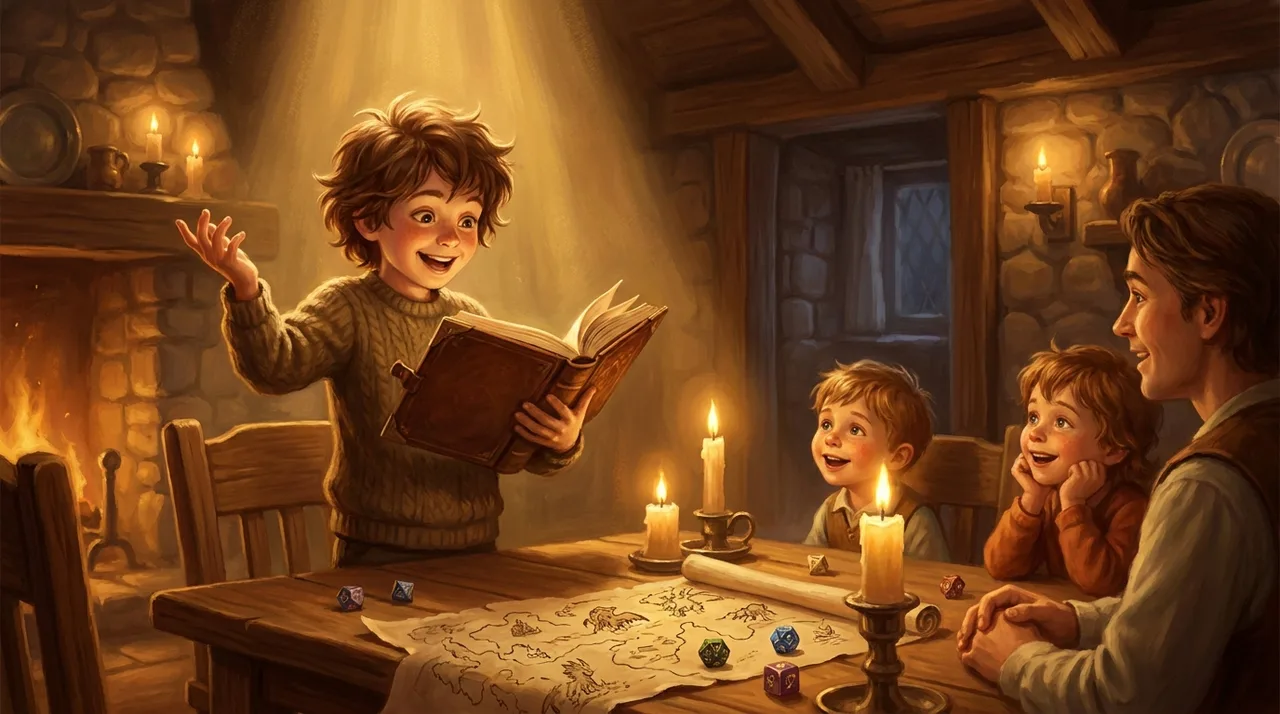
Games that get kids reading out loud
Reader's theater
Reader's theater is the classic for a reason: kids each take a part in a short script and perform it by reading their lines aloud, no memorizing and no costumes required. Because they reread their lines to get the delivery right, they practice the same words several times without it feeling like drilling.
Teachers lean on it because it builds fluency while giving every child a low pressure reason to read aloud. Reading Rockets explains how it works in their piece on giving students a reason to read aloud, and you can run a simple version at the kitchen table tonight.
Story and word games
Card games and board games that make you read prompts, clues, or character cards sneak in a lot of reading per turn. Cooperative storytelling games are especially good, since the table builds a tale together and every player reads their piece into the shared story.
The trick is to pick games where reading the card is the move, not a speed bump before the move. If a child can win by guessing or by waiting for someone else to read, they will, so choose games that put the words in their hands.
Comics, audiobook duets, and choose your path
Comics and graphic novels carry a stigma with some parents, but they are reading, and they are often the bridge a reluctant reader actually walks across. Reading along with an audiobook is another gentle on ramp, since the narrator models pace and expression while the child follows the words.
Choose your own path books turn reading into a game of consequences, where you read a page to decide what happens next. All three lower the wall, and any forward motion is progress worth celebrating.
A tabletop role playing adventure
This is the one that hits all four traits at once. In a tabletop role playing game, each player is a character in a shared story, a storyteller sets the scene, and the table takes turns reading and deciding what happens next.
Reading is the whole engine. Your child reads the scene to know what is going on, reads their character's moment aloud when it is their turn, and then says what they do next in their own words, which is reading and writing and reasoning stacked into one happy minute of play.
It also rides a wave your kid may already love. The hobby roared back into the mainstream when Stranger Things put a group of kids around a game table at the center of the show, and tabletop adventures are cool again for a whole new generation. If you want the deeper version of why this kind of play exercises reading, my guide to how tabletop RPGs build reading comprehension breaks it down.
How to set it up without it backfiring
The fastest way to ruin a reading game is to announce that it is a reading game. Call it game night, not practice, and let the reading be invisible inside the fun.
- Start short. A quick session your child finishes beats a long one they bail on. Win, then play again next week.
- Read with them, not at them. Take a part yourself, ham it up, and miss a word on purpose now and then so they see it is no big deal.
- Never correct mid sentence. Let them finish the thought, and only help with a word if they ask or clearly stall.
- Follow their taste. Dragons, heists, spooky houses, talking animals: pick the flavor they already love and the words go down easy.
Keep the bar low and the laughs high. A reluctant reader who had fun tonight is a reluctant reader who comes back tomorrow, and coming back is the whole game.
New adventures, straight to your inbox
Get the StartRPG newsletter for fresh one-shots, game night ideas, and tips for hosting a table with friends.
We respect your privacy. Unsubscribe at any time.
Why the table beats the worksheet
Reading for pleasure has been sliding for years, and the drop tracks closely with kids deciding that reading is something done to them rather than something they do. Scholastic's Kids and Family Reading Report documents that fall off, and the kids most likely to keep reading are the ones who get to choose what they read and find it genuinely fun.
A game flips the frame. Instead of reading because you must, your child reads because they want to know what is behind the door, and that small shift in motive is exactly what the experts keep pointing to.
You are not tricking anyone. You are giving reading a purpose worth showing up for, which is the most honest thing you can do for a kid who has decided books are not for them.
Play one tonight
If you want a game that gets a reluctant reader reading aloud with the least possible setup, a text first adventure is hard to beat. There is no rulebook to study, a tireless storyteller runs the whole tale, and your child reads their way through it from the first scene.
One honest note before you hit start. It is a fantasy role playing game, so the story can include danger, monsters, and combat, and there is no kid mode or content lock yet. Pick the Lighthearted romp mood for the lightest tone, play a quest yourself first to vet it, and sit in on the game the way you would any new show.
You can grab the family or a few friends and start an adventure together in about a minute. It is genuinely the simplest place to begin, an easy rpg with no prep, no math, and a story that only moves when someone reads the next line. For more ways to build the night around it, my list of tabletop RPG night ideas gives you a ready made plan.
Frequently asked questions
What games help reluctant readers the most?
The ones where reading is the action you take to play, with a real audience and no penalty for a stumble. Reader's theater, cooperative storytelling games, choose your path books, and tabletop role playing adventures all fit, because the child reads to move the game forward rather than to pass a test.
My child hates reading aloud. How do I start?
Start with a game, read alongside them, and make it clear that mistakes are part of the fun. Take a part yourself, keep the session short, and let them pick a theme they already love so the words feel like a way in, not a chore.
Are comics and graphic novels real reading?
Yes. Comics and graphic novels build vocabulary, comprehension, and the habit of reading, and they are often the bridge that gets a reluctant reader to enjoy words at all. Forward motion is the goal, and any reading the child chooses counts.
How long should a reading game night be?
Short enough that your child finishes wanting more. A quick session they complete builds far more momentum than a long one they abandon, so aim to end on a high note and play again another night.
Does a tabletop adventure really involve that much reading?
It does. Your child reads the scene to understand it, reads their character's moment aloud on their turn, and writes their next move in their own words, so reading and writing happen constantly inside the play. The reading is the game, not a side task.
Turn reading into game night
Grab your kids or a few friends, pick a quest, and let a tireless storyteller run the rest. The story only moves when someone reads the next line, and nobody has to study a rulebook first.